Scaling Up Soups and Sauces: What to Know Before Expanding Production

When consumer demand grows, food manufacturers face an exciting opportunity—and a serious challenge: scaling up production. For soup and sauce producers, moving from small-batch operations to full-scale manufacturing involves more than just bigger pots and more staff. It requires careful planning, investment in the right technology, and strict adherence to safety and quality standards.

At DC Norris, we’ve helped food brands worldwide streamline their soup production process and scale with confidence. Learn more about our capabilities here: DC Norris — Soups & Sauces Food Solutions.

Here are key considerations before expanding your production:

Optimise Existing Processes Before Scaling

Before pushing up output volumes, it’s essential to audit your current workflows:

  • Identify inefficiencies, bottlenecks, or steps that slow throughput.
  • Ensure consistency across batches (taste, texture, viscosity).
  • Strengthen your quality control protocols and traceability.

A lean, well‐tuned base process is far easier to scale reliably.

Invest in Scalable and Automated Equipment

Moving from artisanal or pilot-scale operations to full-scale production means leveraging machines designed for industrial volumes. Automated kettles, high-shear mixers and full soup production lines can deliver consistency, safety, and cost efficiency.

Scalable equipment allows you to:

  • Maintain uniform cooking and heat transfer
  • Reduce manual handling and labour costs
  • Improve traceability and in-line monitoring
  • Expand production flexibly as demand increases

You can combine such hardware with software to manage and standardise your recipes—which brings us to another key tool: recipe management systems.

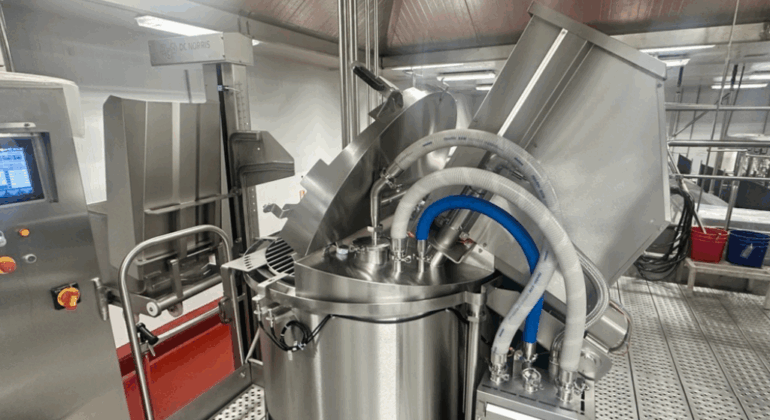
DC Norris soup production process equipment

Leverage Recipe Management Software

When scaling, you’ll want digital systems to manage versions, track batch records, and adjust formulations. DC Norris offers a Recipe Manager Software solution designed to help manufacturers:

  • Store and control multiple recipe versions
  • Scale ingredient quantities with constraints
  • Track batch history and changes
  • Ensure version integrity during scale-up

Learn more here: DC Norris — Recipe Manager Software

Pairing recipe software with proper hardware helps maintain consistency, quality, and regulatory compliance as you grow.

Ensure Compliance with UK Food Safety Regulations

Food safety must scale with production. In the UK, compliance with Food Standards Agency (FSA) rules is essential. You must adopt HACCP-based procedures to assess hazards and control critical points in your processes.

  • Establish critical control points (e.g. cooking temperature, pH, time)
  • Monitor and log conditions continuously
  • Validate processes to ensure pathogen reduction

For official guidance, see the FSA’s HACCP documentation.

Maintaining compliance even as you expand is not optional—it’s foundational to protecting your brand and consumers.

Adapt Recipes for Large-Scale Production

Scaling recipes is more complex than multiplying by a factor.

  • Heat transfer and mixing dynamics change with volume
  • Viscosity and flow behaviour may shift
  • Ingredients (especially spices, thickeners, emulsifiers) can interact differently
  • Batch times, heating/cooling curves, and retention may need re-engineering

Engaging food process experts helps ensure that your scaled-up soups and sauces retain their signature flavour, texture, and safety.

Final Thoughts

Expanding your soup or sauce production is a major undertaking. By refining your current process, investing in scalable machinery, adopting recipe management software, ensuring regulatory compliance, and carefully reengineering your formulations, you set yourself up for success.

At DC Norris, we are uniquely equipped—with both food process systems and software tools—to support your journey from test kitchen to full-scale factory. Our solutions for soups and sauces and our recipe management systems work hand-in-hand to ensure you scale intelligently.

Ready to Scale Up?

If you’re preparing to expand your soup production line, optimise your formulation workflows, or integrate recipe management, let’s talk.

Contact DC Norris today to discuss your scale-up goals and explore how our systems and software can help you grow reliably.

The post Scaling Up Soups and Sauces: What to Know Before Expanding Production appeared first on DC Norris.



Read More

Ready Meal Manufacturing: Building Compliance into Your Ready Meal Line

For ready meal manufacturers, compliance with UK food legislation is more than a legal requirement – it is fundamental to protecting consumers and building brand reputation. The ready meal production process involves sourcing, cooking, cooling, packing, and distributing meals at scale, all of which present food safety risks if not carefully managed.

This guide outlines the key areas where compliance must be built into your ready meal line.

HACCP in Ready Meal Production: A Legal Requirement

UK law requires all ready meal manufacturers to establish a Food Safety Management System based on HACCP (Hazard Analysis and Critical Control Point) principles. This systematic approach involves:

  • Identifying potential hazards such as microbiological contamination, foreign bodies, or chemical risks.
  • Determining Critical Control Points (CCPs) where controls can be applied, such as cooking, cooling, or metal detection.
  • Setting monitoring procedures and corrective actions to ensure hazards remain under control.

Embedding HACCP into your ready meal production process not only safeguards food safety but also provides the documented evidence needed for audits and inspections.

Food Safety Act 1990: What Ready Meal Manufacturers Must Know

Cook chill bags being used in ready meal production process

The Food Safety Act 1990 provides the legislative foundation for all food safety in England, Wales, and Scotland. It requires that food businesses:


  • Do not add or remove anything that could make food unsafe.
  • Do not treat food in any way that could cause harm.
  • Ensure food is of the nature, substance, and quality expected by consumers.

For ready meal manufacturers, this means that every ingredient, process, and packaging step must be designed to deliver safe, consistent, and accurately labelled products.

Traceability in the Ready Meal Production Process

Traceability systems are essential in modern ready meal production. Producers must be able to track ingredients and finished meals at every stage of the supply chain. This ensures that, if an issue arises, a targeted and efficient recall can be executed.

Accurate records – from supplier documentation through to temperature logs and cleaning schedules – demonstrate compliance to regulators and reassure customers that robust systems are in place.

Temperature Control Regulations in Ready Meal Production

Strict temperature management is one of the most critical aspects of compliance. UK regulations require:

  • Cold ready meals to be stored at 8°C or below.
  • Hot foods to be held at 63°C or above until served or cooled for storage.

Failing to maintain these standards creates an environment where harmful bacteria can grow. Many manufacturers are adopting automated monitoring systems to maintain temperature control and provide continuous data records for compliance.Pilau rice in vessel for ready meal production equipment.


Building Compliance into Every Stage of Ready Meal Production

Compliance is not a single action but a continuous process, woven into every part of ready meal production – from raw material intake to distribution. By embedding food safety into daily operations, manufacturers can ensure legal compliance, safeguard consumer health, and protect their reputation.

How DC Norris Supports Ready Meal Manufacturers

At DC Norris, we design and build equipment that helps ready meal manufacturers meet compliance requirements while achieving efficiency and consistency in production. Our systems include:

By working with DC Norris, manufacturers can be confident that their ready meal production process is built on a foundation of safety, compliance, and efficiency.Overcome your food processing challenges with our latest guide. click her to download now!

The post Ready Meal Manufacturing: Building Compliance into Your Ready Meal Line appeared first on DC Norris.

Read More

Innovating Beverage Processing: The Role of Advanced Industrial Equipment

The beverage sector is undergoing rapid transformation. Changing consumer preferences, sustainability demands, and the push for extended shelf-life are all shaping the way manufacturers approach production. As the food and beverage processing equipment market evolves, producers are seeking advanced systems that balance efficiency, product quality, and energy use.

One area of particular innovation is the sterilisation and heating of beverages, especially those containing sensitive ingredients like dairy proteins, grains or fruit juices. These types of products are increasingly popular but also present unique processing challenges.

The Challenges of Heating in Beverage Processing

For many drinks, particularly those that are fruit-based or dairy-enriched, it’s essential to preserve natural characteristics such as colour, flavour and texture. These attributes are easily degraded through traditional heating methods like steam heat exchangers, which rely on conduction and convection through hot surfaces. These surfaces can reach very high temperatures, risking denaturation of proteins, caramelisation of sugars, and loss of nutritional value.

This issue is especially critical in the production of premium beverages, such as fruit-based juices, protein shakes and dairy alternatives, where ingredients like whey protein isolate or fresh fruit pulp can be extremely sensitive to heat.

A New Approach to Thermal Processing

To address these challenges, new types of beverage processing equipment are emerging that offer more controlled and efficient methods of heating. One such example is Jet Sterilisation, a direct, in-line heating technology developed by DC Norris.

Unlike traditional methods, Jet Sterilisation delivers energy directly into the product via multiple in-line Jet Cook units. This rapid, single-pass process can raise product temperatures to 148°C in seconds, reducing the time the product is exposed to heat and preserving its organoleptic and nutritional properties. Because there are no excessively hot surfaces, burn-on is eliminated — a significant advantage in cleaning, product yield, and maintaining consistent quality.

Applications and Advantages

Jet Sterilisation is particularly well-suited to complex beverage formulations. For example, hydration times for grains such as crushed oats or maize — key ingredients in many non-dairy drinks — are significantly reduced. This is due to the system’s ability to produce trillions of microscopic droplets in a partial vacuum environment, which penetrate ingredients efficiently and evenly.

Texture and consistency are also critical in beverage manufacturing. Drinks such as Maheu and Brushera require different textures depending on consumer preference and market. The Jet Sterilisation System offers fine control through its non-mechanical shear function, allowing manufacturers to tailor mouthfeel without additional processing stages.

Energy Efficiency and Sustainability

Energy consumption is a growing concern in the food and beverage processing equipment market. With Jet Sterilisation, the majority of the steam’s energy is transferred directly into the product, making the process more energy-efficient than conventional systems. This not only reduces operating costs but supports broader sustainability goals — a key driver for manufacturers across global markets.

Streamlined Processing with Fewer Moving Parts

Another operational advantage is system simplicity. Jet Sterilisation uses minimal pipework, has no moving parts in contact with the product, and can be disassembled for cleaning in minutes. In contrast to complex heat exchanger systems, this reduces downtime, cleaning labour, and product loss.

Furthermore, Jet Sterilisation can be integrated into wider processing lines such as the DCN Jet Process System — a modular setup that combines Jet Cook, Jet Entrain, Jet Heat, and Jet Clean technologies for complete inline processing of extended shelf-life beverages and liquid foods.

Global Impact

With installations worldwide, including in Africa where multiple systems are producing 65 tonnes of beverages every hour, Jet Sterilisation is proving to be a valuable asset in high-volume, high-quality production. A development kitchen based at the Cape Town Peninsula University of Technology also supports local manufacturers with trials and process development.

Looking Ahead in Beverage Processing

As the demand for diverse, high-quality, and shelf-stable beverages continues to rise, so too does the need for advanced food and beverage processing equipment. Technologies like Jet Sterilisation represent a shift toward smarter, more efficient production, where product integrity, energy savings, and operational simplicity are no longer mutually exclusive.

For beverage manufacturers navigating the evolving market landscape, embracing these innovations is becoming less of an option and more of a necessity. Get in touch with our experienced team here at DC Norris today. 


The post Innovating Beverage Processing: The Role of Advanced Industrial Equipment appeared first on DC Norris.

Read More

How Automation in Food Processing Systems is Streamlining Beverage Production

In today’s fast-paced food and beverage industry, manufacturers are under constant pressure to increase output, reduce costs, and uphold the highest standards of quality. At DC Norris, we understand that automation is key to meeting these challenges, particularly in beverage production, where speed, consistency, and hygiene are non-negotiable.

Increased Productivity

Automated food processing systems are revolutionising beverage production by dramatically increasing productivity. These systems operate continuously, without fatigue or slowdown, allowing for 24/7 operation. This constant throughput enables producers to scale up quickly and meet growing market demand with ease. Whether it’s mixing, heating, filling, or cooling, automation ensures every stage of the process runs at peak efficiency.

Long-Term Cost Savings

While the initial investment in automation technology may seem substantial, the long-term financial benefits are compelling. Automation significantly reduces the need for manual intervention in repetitive and time-intensive tasks, cutting labour costs and lowering the risk of human error. Additionally, by improving operational efficiency and reducing material waste, automated systems contribute to leaner, more cost-effective production lines.

Enhanced Precision and Consistency

Delivering a uniform taste, texture, and appearance in every bottle is critical in beverage manufacturing. Automated systems excel in this area by performing tasks with remarkable precision and repeatability. From measuring ingredients to controlling temperatures and mixing times, automation ensures consistent product quality, batch after batch—a key differentiator in an increasingly crowded marketplace.

Improved Quality Control

At DC Norris, we believe that quality should never be compromised. Automation supports this principle by integrating advanced monitoring and control technologies throughout the production line. Real-time data collection, inline sensors, and automated checks help identify and correct any issues on the spot. This proactive approach not only maintains product integrity but also reduces the risk of costly recalls and enhances consumer trust.

The DC Norris Advantage

As a global leader in food processing technology, DC Norris designs and manufactures turnkey systems that bring the benefits of automation directly to your production floor. Our advanced solutions for beverage processing combine decades of engineering expertise with the latest in automation technology, helping our partners achieve higher productivity, lower costs, and superior product quality. 

Ready to transform your beverage production with automation?
Contact DC Norris today to learn how we can help future-proof your processing systems

The post How Automation in Food Processing Systems is Streamlining Beverage Production appeared first on DC Norris.

Read More

Top Considerations for Choosing High-Capacity Industrial Cooking Systems

As the food manufacturing industry evolves to meet increasing demand and stringent quality standards, selecting the right high-capacity industrial cooking system becomes paramount. Whether you’re upgrading existing operations or establishing a new facility, thoughtful consideration of several critical factors will ensure your investment supports both current needs and future growth.

1. Capacity and Scalability

Begin by assessing your current production volumes and anticipating future expansion. The ideal industrial cooking equipment should not only accommodate present output but also offer scalability. Systems with adjustable batch sizes or modular designs provide flexibility, allowing for seamless adaptation to changing production demands without compromising efficiency.

2. Material Quality and Durability

In the demanding environment of food manufacturing, equipment durability is non-negotiable. Opt for industrial food processing equipment constructed from high-quality, corrosion-resistant materials, such as 316 stainless steel for food contact surfaces. Robust construction ensures longevity, maintains compliance with food safety standards, and minimises contamination risks.

3. Compliance with Regulatory Standards

Adherence to food safety regulations is critical. Ensure that your chosen food processing machinery meets relevant industry certifications, including FDA, USDA, or CE standards. Equipment designed with compliance in mind helps avoid legal complications and safeguards your brand’s reputation.

4. Ease of Maintenance and Cleaning

Operational downtime can be costly. Prioritise equipment engineered for easy maintenance and sanitation. Features like smooth surfaces, removable parts, and accessible components simplify cleaning processes, uphold hygiene standards, and enhance overall operational efficiency.

5. Return on Investment (ROI)

While the initial investment in high-capacity cooking systems may be substantial, consider the long-term financial benefits. Evaluate how the equipment will improve productivity, reduce labour costs, and minimise waste. A thorough cost-benefit analysis will highlight the potential for significant ROI over time.

6. Automation and Technological Integration

Modern industrial food processing equipment often incorporates advanced automation features. Automated systems enhance precision, ensure consistent product quality, and reduce human error. Integration with data management tools allows for real-time monitoring and control, facilitating informed decision-making and process optimisation.

7. Sustainability and Energy Efficiency

Sustainable practices are increasingly important in food manufacturing. Select equipment designed to minimise energy and water consumption, thereby reducing environmental impact and operational costs. Energy-efficient systems contribute to a smaller carbon footprint and align with global sustainability goals.

8. Supplier Expertise and Support

Partner with suppliers who offer comprehensive support, from initial consultation to after-sales service. Access to expert teams for training, maintenance, and technical assistance ensures that your food processing machinery operates at peak performance and adapts to evolving production requirements.

Making the Right Investment for Long-Term Success

Investing in the right high-capacity industrial cooking equipment is a strategic decision that influences your production efficiency, product quality, and long-term profitability. By focusing on capacity, durability, compliance, maintenance, ROI, automation, sustainability, and supplier support, you can make an informed choice that positions your operation for success in the dynamic food manufacturing landscape.

For more detailed guidance on selecting the optimal industrial food processing equipment for your specific needs, consider consulting with industry experts who can provide tailored solutions and support.

Ready to consider High-Capacity Industrial Cooking Systems?
Contact DC Norris today to learn how we can help future-proof your processing systems.


The post Top Considerations for Choosing High-Capacity Industrial Cooking Systems appeared first on DC Norris.

Read More

What Is Jet Cook™ Technology? A Game Changer for Liquid Food Processing


In the fast-moving world of liquid food processing, manufacturers are under constant pressure to improve efficiency, reduce energy use, and deliver consistently high-quality products. One technology that’s proving to be a true game changer is the Jet Cook™ system, developed in the UK by DC Norris.

Using advanced steam technology, Jet Cook™ offers an innovative approach to cooking and mixing liquid products – delivering speed, consistency, and sustainability benefits that far surpass traditional methods.

Revolutionary Advanced Steam Cooking

At the heart of the DC Norris Jet Cook system is a patented advanced steam technology that delivers rapid heating, mixing, and pumping in a single, highly efficient process.

High-velocity steam is atomised into over seven trillion droplets per second through a specially designed steam conditioning chamber and annular nozzle. As the steam collapses into the product, it creates a partial vacuum, pulling the product through the system and back into the vessel—simultaneously heating and mixing without mechanical agitation.

With 99.5% of the steam’s energy transferred directly into the product, manufacturers benefit from:

  • Faster processing times – typically 50% quicker than conventional methods
  • Up to 52.5% energy savings
  • Improved product quality and particulate integrity
  • Fewer processing stages and reduced cleaning requirements

Enhanced Product Quality and Consistency

Uniform heating and precision control are key strengths of the Jet Cook system. By achieving even distribution of temperature throughout the batch, it ensures:

  • Superior texture and mouthfeel
  • Improved flavour development
  • Strong emulsions
  • Reduced particulate damage
  • Minimal risk of overcooking or uneven heating

These qualities are essential in products like soups, sauces, purées, and beverages, where ingredient integrity and consistency are paramount.

Significant Energy and Resource Savings

Sustainability is a major focus in food production today, and Jet Cook™ helps manufacturers meet these goals without compromising performance. The system:

  • Reduces energy usage by up to 52%
  • Requires significantly less water for cleaning, thanks to zero burn-on contamination
  • Decreases waste and improves overall plant efficiency

These savings translate to lower operational costs and a reduced environmental footprint—key benefits for food producers aiming to future-proof their processes.

Technological science behend the Jet Cook for food processing

Versatility Across Liquid Food Applications

Jet Cook™ is not limited to one product type. Its adaptable design allows it to process a wide range of liquid food products with ease, including:

  • Sauces, gravies, and soups
  • Dairy and non-dairy beverages
  • Plant-based recipes and baby foods
  • Ready meals and functional nutrition products
  • Animal and insect food

Whether you’re scaling up production or developing a new product range, the Jet Cook system offers the flexibility to handle diverse recipes while maintaining consistency and quality.

Flexible Integration Options

The Jet Cook™ system can be tailored to suit a wide range of production setups. It can be used in-tank as part of a DCN Kettle System or in-line for continuous single-pass heating. The system can also be retro-fitted to existing equipment, offering manufacturers a cost-effective upgrade path without major plant modifications.

Installed across global food manufacturing facilities—from the UK and Europe to the Middle East, Australia, and North America – Jet Cook™ is helping producers transform how liquid food products are made.

Why Jet Cook™ Is the Future of Liquid Food Processing

As consumer demands evolve and production targets grow more ambitious, food manufacturers need equipment that can keep up. The DC Norris Jet Cook system delivers unmatched performance in speed, quality, sustainability, and flexibility – making it a powerful solution for modern liquid food processing.

Want to learn more about how Jet Cook™ technology can improve your production line? Get in touch with the DC Norris team today.

The post What Is Jet Cook™ Technology? A Game Changer for Liquid Food Processing appeared first on DC Norris.

Read More

How Automation Supports the Upscaling of Food Processing Operations

As demand for ready meals, sauces, and other prepared foods continues to grow, manufacturers are turning to automation in food processing to help scale production while maintaining quality and safety standards. Automation has become a key enabler for producers looking to increase output, improve consistency, and adapt to ever-changing consumer and retailer requirements.

At DC Norris, we work closely with food manufacturers around the world to implement industrial food processing equipment that streamlines operations and supports scalable growth. Below, we explore how automation in the food processing industry is transforming large-scale production.

Automation in Food Processing Boosts Production Efficiency

One of the most immediate benefits of automation is the significant increase in production efficiency. Automated systems manage repetitive tasks with high precision, reducing downtime and eliminating bottlenecks.

For example, integrating slicers, depositors, and topping applicators into a continuous processing line allows manufacturers to handle larger volumes with ease. These systems ensure each product is processed to exact specifications, reducing waste and rework while maintaining consistent quality.

Automation software plays a crucial role. Advanced Recipe Manager Software enables operators to run complex processes with consistency and repeatability. Recipes are pre-programmed and controlled centrally, ensuring each batch is produced to exact parameters, no matter who is operating the line. This eliminates variability and supports efficient scale-up.

Flexible and Scalable Solutions for the Food Processing Industry

Modern automation in the food processing industry is no longer one-size-fits-all. Today’s advanced robotic and control systems are built for flexibility, allowing easy reconfiguration to meet changing production needs.

Whether producing ready meals, sauces, or plant-based alternatives, manufacturers can adapt their systems to different recipes, packaging formats, or portion sizes without extensive manual intervention. This flexibility is essential in sites producing a wide range of products or responding to seasonal demand.

With Recipe Manager Software, operators can switch between validated recipes at the touch of a button. This streamlines changeovers, minimises risk, and ensures full traceability, with every process step securely logged for compliance and quality assurance.

Reducing Labour Costs with Industrial Food Processing Equipment

Ongoing labour shortages and rising wage costs continue to impact food manufacturing worldwide. Industrial food processing equipment provides a practical solution by automating repetitive or physically demanding tasks.

By reducing reliance on manual labour, companies can reallocate their workforce to higher-value roles in quality control, maintenance, and innovation. Automation also simplifies training: with intuitive software, even new operators can produce consistently high-quality results.

Improving Food Safety, Product Consistency and Traceability

Automation in food processing plays a critical role in enhancing food safety, maintaining product consistency, and ensuring traceability. By reducing the reliance on manual intervention, automated systems help minimise the risk of human error, a common cause of contamination, mislabelling, and non-compliance.

Modern automation software can digitally monitor and log key process parameters such as temperature, pressure, and cooking time. These secure records support traceability across every batch and provide valuable data for audits, compliance checks, and quality assurance.

In the event that process conditions deviate from the specified range, alerts can be generated in real time, allowing operators to respond quickly and prevent a compromised product from continuing down the line. When integrated with recipe management systems, this creates a centralised, data-driven environment where consistent product quality is achieved and easily verified — a crucial advantage in high-volume food production.


The Future of Automation in Food Processing

Automation in the food processing industry is no longer a luxury,  it’s a necessity for manufacturers aiming to scale up operations, meet growing demand, and remain competitive. Intelligent, hygienic, and scalable solutions are vital for long-term success.

At DC Norris, we design and manufacture industrial food processing equipment and automation software that help customers around the world scale up with confidence. Whether you’re expanding production or optimising your existing setup, our team is ready to support you at every stage — from trials to installation and beyond. Get in touch with our experienced team today!


The post How Automation Supports the Upscaling of Food Processing Operations appeared first on DC Norris.

Read More

Product Spotlight: DC Norris Manual Bag Emptier – Proven Performance, Maximum Yield

At DC Norris, we engineer solutions that deliver real-world results. Our Manual Bag Emptier / Scraper stands out as a high-performance solution specifically designed for the efficient and hygienic emptying of chilled product bags—even with varying viscosity.

Proven Performance – Backed by Data

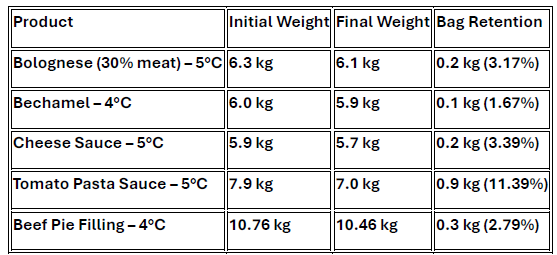
In recent trials involving chilled products with viscosities from 500Cp to 17,000Cp, our solution achieved a bag retention as low as 0.1 – 0.2 kg per bag, equating to less than 1.5% product loss in most cases.

Here’s a snapshot of our test results:

Engineered for Precision & Hygiene

Featuring integrated roller blade, the system ensures smooth product transfer with minimal manual effort. Its design supports chilled operations (4°C to 5°C), making it ideal for handling high-viscosity products like sauces, dairy-based mixtures, and pie fillings.

✅ Key Benefits:

  • Efficient removal of high-viscosity and chilled food products.
  • Reduces product wastage to less than 1.5% (product specific), ensuring maximum yield.
  • Roller blade technology for hygienic and thorough scraping.
  • Built with DC Norris’ renowned hygienic stainless-steel design.

Ready to Improve Your Production Efficiency?
The Manual Bag Emptier / Scraper is the smart choice for food processors looking to minimise waste and improve throughput.

To learn more about how our Manual Bag Emptier can benefit your business, or to request a demonstration, contact DC Norris today.


The post Product Spotlight: DC Norris Manual Bag Emptier – Proven Performance, Maximum Yield appeared first on DC Norris.

Read More

Advantages of AutoCan 1000 Automatic Can Opening & Crushing in High-Volume Food Production Environments

As global demand intensifies for faster, safer, and more sustainable food manufacturing, DC Norris is proud to introduce the AutoCan 1000 — a fully integrated can opener and crusher designed to transform can handling in large-scale food production environments.

More Than a Can Opener — A Complete Waste-Reducing Solution

 Manufactured in the UK, the AutoCan 1000 goes far beyond conventional industrial can openers. This next generation system automates the opening of up to 1,000 cans per hour and performs four critical tasks in a single streamlined process:

  • External rinse to remove debris
  • Precision opening with burr-free, magnetic lid removal
  • Automated emptying, including a jogging system for stubborn contents
  • Internal rinse (optional) to recover residual product
  • Post-use can crushing to minimise volume and optimise recycling

By combining these steps into one compact unit, the AutoCan 1000 helps food manufacturers achieve measurable savings in labour, time, waste disposal costs, and manual handling risks — all while supporting corporate sustainability goals through improved recycling efficiency.

Meeting the Needs of Modern Production Environments

In commercial kitchens, central production units, and high-volume factories, can handling is traditionally a repetitive and labour-intensive process prone to hygiene issues and inconsistencies. The AutoCan 1000 eliminates these inefficiencies with:

  • Automatic height adjustment for varied can sizes and different products
  • Tool-free cutting head change for maximum flexibility
  • Fully enclosed operation for enhanced safety and hygiene
  • Minimal operator input, freeing staff for higher-value tasks

Built-In Hygiene and Low-Maintenance Design

Safety is engineered into every element of the AutoCan 1000. The unit operates fully enclosed to eliminate blade exposure and contact with sharp edges, while automatic ejection and transfer of cans between stages reduces manual handling. Combined with its hygienic stainless-steel construction and sealed motor, the system supports clean, safe operation in even the most demanding environments.

Supporting Circular Economy Goals

One of the AutoCan 1000’s key advantages lies in its waste reduction capabilities. By crushing cans post-emptying, the system reduces waste volume at the source, making on-site recycling easier, more cost-effective, and environmentally responsible. This supports processors in their efforts to reduce their carbon footprint and comply with tightening regulations around packaging and waste.

Scalable, Sustainable, and Built for Performance

Whether you’re producing soups, ready meals, or pet food, the AutoCan 1000 is a scalable, future-ready solution that delivers long-term performance. From increasing throughput to reducing waste and enhancing workplace safety, it provides genuine operational and environmental benefits for modern food manufacturers.

Discover how the AutoCan 1000 can improve your production efficiency and sustainability targets. Contact DC Norris today or visit our website to arrange a demonstration.


The post Advantages of AutoCan 1000 Automatic Can Opening & Crushing in High-Volume Food Production Environments appeared first on DC Norris.

Read More

DC Norris Group Announces Landmark Project in North America, Showcasing Streamlined Global Approach

We are pleased to announce that our North American division has secured one of the largest projects in its ten-year history. This milestone marks the first installation to move forward under our newly streamlined delivery model, reflecting the growing demand for a more coordinated approach to sourcing and installing food processing equipment across multiple brands and applications.

Our centralised model gives manufacturers in the United States and Canada direct access to an expanded equipment portfolio manufactured within the DC Norris Group of companies. This includes world-class food processing systems from DC Norris (UK), BCH, Gilwood, and AE Mixers. By acting as a single point of contact, DC Norris North America ensures clients benefit from integrated engineering, shorter project timelines, and consistent support from planning through to commissioning.

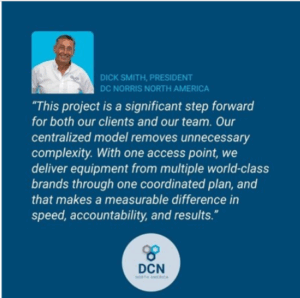
“This project represents an important step for our global operations,” said Dick Smith, President of DC Norris North America. “The centralised model being implemented in North America highlights how our Group can simplify project delivery, reduce complexity for customers, and provide a seamless service, no matter where they are in the world.”DC Norris North America 's Dick Smith

Key benefits of our centralised access model include:

  • Integrated system design that minimises compatibility issues and ensures reliable start-up

  • Single accountability for project delivery, training, and performance

  • Accelerated installation and commissioning with unified support

  • US based service engineers supported by a robust domestic spare parts inventory, with direct access to additional stock held in the UK

  • Ongoing collaboration with the original equipment manufacturers for long-term operational efficiency

This landmark project sets a new benchmark for the DC Norris Group and demonstrates the strength of our global approach to equipment supply and project execution.

DC Norris North America will be exhibiting at Pack Expo Las Vegas, September 29 through October 1, 2025 in booth N-6862 where attendees will experience all four portfolio brands showcased. Company leadership and sales engineers will be on hand to discuss equipment applications with manufacturers and take media interviews at the Las Vegas show.

If you would like to learn more about our collaborative projects or discuss how we can support your next installation, please contact us

Pack Expo

The post DC Norris Group Announces Landmark Project in North America, Showcasing Streamlined Global Approach appeared first on DC Norris.

Read More

Want to get in Touch?

That's easy, just find our locations on the map